Moriarty Strikes Again Answers Digital India
"Clocks" is one of the prime number topics one should study to solve the questions appearing in the public sector archway exams. It is a significant part of logical reasoning, which non merely involves an in-depth logical assay just as well pertains to a detailed level of calculation to solve the questions in the right way.
In this article, nosotros bring to you the detailed concept of Clocks and the types of questions which may be asked regarding the same. Likewise, candidates can practise the aforementioned clock questions PDF given in this article to get a better understanding of the topic. It is a common topic with regard to the various Government exams conducted across the country.
To know more than well-nigh bank exams, check at the linked article.
Every yr, Clocks course an integral part of the question paper of the following list of Govt. exams that include:
- IBPS Specialist Officer
- RRB Assistant Loco Pilot
- Staff Choice Commission (SSC)
- SBI PO
- SBI Clerk
- SBI SO
- IBPS PO
- IBPS Clerk
To explore various SBI exams, cheque at the linked article.
15+ Clock Questions & Answers PDF:- Download PDF Hither
Check out the video given beneath to understand the concept of Clocks fifty-fifty better and analyse the best ways to answer questions under this department:
Introduction
A Clock is a circular device provided with iii easily viz. an hour hand, minute and second mitt. The study of the clock is known as "horology".
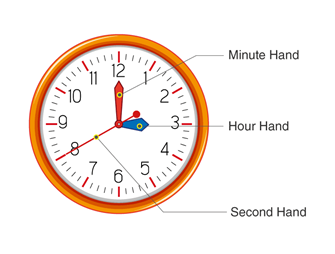
A bones structure of a clock with three hands
Construction of a Clock
A clock is composed of 360 degrees and divided into 12 equal divisions. The angle between the sequent divisions is obtained by dividing the total bending of clock 360° by the number of divisions i.e. 12 .
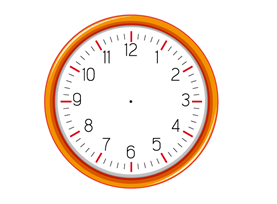
Twelve equal divisions of a clock
The angle between whatsoever ii consecutive divisions = (360°)/12= 30°
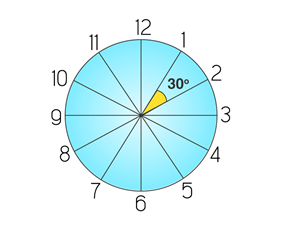
Bending divisions of a clock
A close observation of a clock reveals that an angular space between any two consecutive divisions has further five more divisions. The area betwixt the two divisions corresponds to a value of 5 minutes. Hence, dividing the 30° by 5 will result in the athwart value of a infinitesimal.
Athwart value of a minute = (30°)/5= 6°
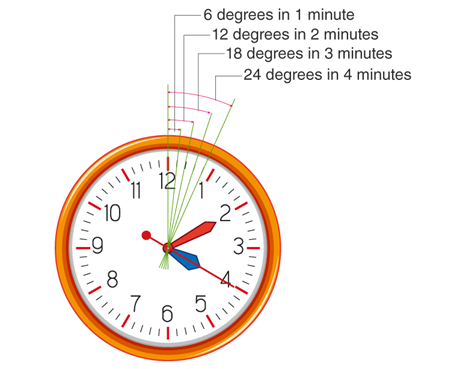
Angular values of minutes
To know more about SBI PO Syllabus, check at the linked article.
Given below are a few reasoning ability concepts to set up for the upcoming Authorities exams:
Angle equivalence of a minute
The table given beneath demonstrates the athwart values of the starting time ten minutes:
| Infinitesimal(s) | Athwart values |
| 1 | vi° |
| ii | 12° |
| 3 | xviii° |
| 4 | 24° |
| 5 | 30° |
| 6 | 36° |
| 7 | 42° |
| 8 | 48° |
| 9 | 54° |
| ten | 60° |
Speed of the hands
A clock has three hooks and all three movement at different rates. The speed of moving object depends on the altitude travelled and the time taken to cover a specific range.
The speed is calculated by:
Speed = Distance/(Fourth dimension taken)
The speed of a minute hand:
A minute hand travels 360° in 1 hour. i.due east. it travels through all the 12 divisions around the clock every hr. (1 60 minutes = hr)
Speed of a minute hand = (360°)/(threescore minutes)
Speed of a minute hand = 6° per minute.
The speed of an hour hand:
An hour hand travels 30° in an hour. i.due east. information technology covers a distance of 5 minutes (the gap between consecutive divisions) in 60 minutes.
Speed of an hour hand = (30°)/(hour)
Speed of an hour hand =1/two ° per minute.
To know more most IBPS Syllabus, bank check at the linked article.
Aspirants can check the detailed section-wise syllabus for the various Government exams at the articles linked below:
Comparison of Speed of hands
The divergence in the speed = vi°– (1/ii°) = 5.five° per minute
Comparing the speed of the minute paw and an hr hand, i can conclude that the minute manus is always faster than the hour hand by 5.5° or an hr hand is always slower than the minute hand by 5.v°
Notation: The evaluation of the speed of second hands is non necessary as information technology travels a corresponding distance of i second in a second.
Frequency of coincidence and standoff of hands of a clock:
As nosotros know the easily of clock moves at different speeds, they coincide and collide and also make different angle formations among themselves at diverse times in a solar day.
Q.i How many times in a twenty-four hours exercise the infinitesimal and hour hands of a clock coincide (Bending between them is zero) with each other?
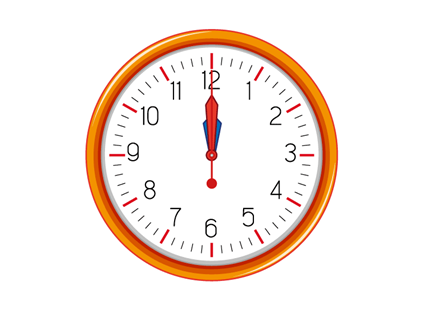
A first standoff of the hands in a clock at midnight
Logical caption:
A day starts at midnight, and hence the first-ever coinciding of easily happen at midnight. Now observing the clock, the side by side coincidence will occur at approximately 1' o'clock and 5 minutes. Thus, one can conclude that every hour, in that location is one coincidence of hands. Therefore, the answer should be 24 times for 24 hours. Merely it is not the correct answer and right logic.
Now observe the fourth dimension between 11 to 12, either it can either be A.M or P.M, the hands are not coinciding betwixt 11'o o'clock and 12'o o'clock. The coinciding of hands at 12' o clock is the coincidence between 12 and 1 and eleven and 12. Hence, in 12 hours, at that place will only exist xi coincidence, extending the logic for 24 hours of the day, there will be 22 coincidences.
If 12:0:0 A.M is the first coincidence of the hands in a day then the adjacent collision will be at one'o o'clock 5 minutes, just the evaluation of seconds is difficult, but non incommunicable.
Logical calculation:
We know in 12 hours at that place will be eleven coincidences. Therefore, one collision volition happen at:
Frequency of one collision = (12 hours)/11
Frequency of 1 collision = (12*threescore mins)/eleven
Frequency of one collision = (720 mins)/11
Frequency of one collision = 65(5/xi)
The value 65(5/11) indicates that the hands of a clock coincide afterward every 65 minutes five/eleven of a infinitesimal. i.e. if 12:0:0 is the first standoff, then the exact time of the next collision will be obtained past adding 65(5/11) to 12 o'clock.
The below tabular array denotes the time at which both the hands of a clock collide:
| Frequency of collision | Time in mixed fraction | Exact time |
| 1st | 12:0:0 | 12:0:0 |
| 2nd | i:5:5/11 | ane:v:27 |
| 3rd | 2:10:x/11 | 2:10:54 |
| fourth | three:16:16/11 | iii:16:21 |
| 5th | four:21:9/11 | iv:21:xvi |
| half-dozenth | 5:27:3/11 | 5:27:36 |
| viithursday | 6:32:eight/eleven | 6:32:43 |
| 8thursday | 7:38:ii/11 | seven:38:10 |
| nineth | viii:43:seven/11 | 8:43:38 |
| 10th | ix:49:1/eleven | ix:49:5 |
| 11th | 10:54:vi/11 | 10:54:32 |
| 12th | xi:59:xi/11 | 12:0:0 |
Q.2 How many times in a twenty-four hour period do the minute and hr easily of clock form a 180° directly line in a twenty-four hours?
The hands of the clock make ane 180° straight line every hour except between 5'o clock and half-dozen'o clock. A precise observation and analysis of the watch gives the idea that between five and vi the easily brand straight line 180° exactly at 6 o'clock and hence, it cannot be the ane which happens between v o'clock and 6 o'clock. Instead it is considered as a direct line formed between 6 and 7 o'clock.
Therefore, the easily of a clock make 180° straight lines 11 times in 12 hours and hence generalising it for 24 hours, the hands make 22 consecutive lines of 180° in 24 hours.
To explore IBPS RRB Syllabus, check at the linked commodity.
Finding the time when the angle is known:
When the angle between the hands are not perfect angles like 180°, 90° or 270°, the solving of the questions becomes difficult and time-consuming at the same time. The logic beneath provides a trick to address bug involving angles of hands for other than standard aspects.
T = 2/eleven [H*30±A]
Where:
- T stands for the time at which the angle formed.
- H stands for an hour, which is running.
(If the question is for the duration between four o'clock and 5 o'clock, it'southward the 4thursday hour which is running hence the value of H will exist '4'.)
- A stands for the angle at which the hands are at present.
(The value of A is provided in the question more often than not)
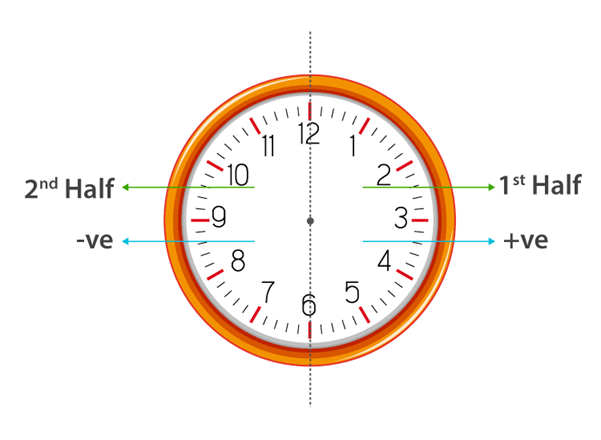
The clock is divided into two parts: 1st and 2nd one-half as shown above
If the time given in the question lies in the kickoff half, then the positive sign is considered while evaluating the fourth dimension else, then the negative sign is used.
Q3: At what time betwixt 3 and 4 o'clock, the hands makes an angle of 10 degrees?
Solution:
Given: H = 3 , A = x
Since both three and four lies in the start half considered a positive sign.
Calculations:
T = 2/11 [H*30±A]
T = 2/11 [3*thirty+10]
T = 2/11 [xc+10]
T = 2/xi [100]
T = 200/11
T =18 2/11
The answer indicates that the hands of a clock volition make an angle of 10 between 3 and 4 o'clock at exactly 3:xviii:ii/11 ( 3' o clock xviii minutes and two/11 of minutes = 2/11*60 = 10.9 seconds)
A few other links to logical reasoning based concept take been given below in the table, candidates tin can refer to the these for whatever kind of assistance:
Correct clock v/due south Wrong clock:
This section involves the comparison of fourth dimension in the accurate clock with the incorrect spotter. The wrong time indicates that a clock is either dull or fast compared to the correct time. The wrong clock tin can either be fast or delayed by a few seconds/minutes/ hours or sometimes by a few days and weeks.
Q.iv A clock gains v seconds for every iii minutes. If the clock started working at vii a.one thousand. in the morning, then what volition be the time in the wrong clock at iv p.m. on the same mean solar day?
Solution:
A clock gains five seconds for every 3 minutes, then it will proceeds l seconds in xxx minutes, or it will larn 100 seconds in 60 minutes. i.eastward. it will proceeds 100 seconds in 1 hour. Since the clock was started at vii a.m. in the morning time and right now the correct fourth dimension is 4 p.grand. the total time the clock has worked is 9 hours. We know that in i hour information technology gains 100 seconds so in ix hours it increases 900 seconds. The conversion of 900 seconds to minutes will be xv minutes. This increase indicates that a clock is faster by 15 minutes as the clock is gaining. Hence, the time in the watch would be 4:15 p.one thousand.
To know more near SSC JE Syllabus, cheque at the linked article.
Other grooming related links:
Puzzle:
Observe the monument. How many minute and hour hand/hands does Big Ben tower clock take?

Reply: It has 4-minute hands and 4-hour hands as there are four clocks on all the 4 sides of it.
Solved examples:
1. An accurate clock shows 7 a.m. Through how many degrees will the 60 minutes hand rotate when the clock shows 1 p.m.?
A. 154° B. 180°
C. 170° D. 160°
Solution:
We know that angle traced past 60 minutes manus in 12 hrs. = 360°
From 7 to 1, in that location are six hours.
Angle traced by the hour hand in 6 hours =half dozen*(360/12)=180°
Option B is the correct reply.
2. By 20 minutes past 4, the 60 minutes hand has turned through how many degrees? If then the clock is 12 p.grand.
A. 100° B. 110°
C. 120° D. 130°
Solution:
At four o'clock the hour hand is at 4 and has an angle of 30°*4=120°
An 60 minutes hand travels i/2° per infinitesimal In 20 minutes information technology volition travel 20 *(1/2°) = 10°. Adding both we get 120° + 10° = 130°
Option D is the correct answer.
3. At what time between 5.xxx and 6 volition the easily of a clock be at correct angles?
A. 44 minutes past v B.44 ( 7/xi) minutes by 5
C.43 ( vii/eleven) minutes past v D. 43 minutes by 5
Solution:
Given: H = 5 and A = 90, since 5 and 6 lies in the kickoff half, a positive sign is considered.
T = two/11 [H*30±A]
T = 2/xi [five*thirty+90]
T = two/xi [240] = 480/11= 43( 7/xi)
Selection C is the right answer.
4. What is the angle between the infinitesimal mitt and the hour hand of a clock at 5.30?
A. 05° B. xv°
C. 25° D. 35°
Solution:
At 5 'o'clock the hour hand is at 5 and hence has made thirty° bending.
From five to 5.30 its will travel for 30 minutes with a speed of ½ ° Therefore the full distance travelled will exist xxx minutes* 1/2 = 15°
The total angle fabricated by the hr hand will be 150°+15° = 165°.
The minute paw at 5 o'clock is at 12, and hence the angle made is zero. In 30 minutes, information technology will travel a distance of 30 minutes with a speed of six° per minute. Therefore, the total distance travelled will be 30 minutes*half dozen° = 180 °.
The angle between the minute and 60 minutes hand is 180 – 165 = xv
Selection B is the right answer.
To know more nearly RRB ALP Syllabus, check at the linked article.
5. How many times in a day, the hands of a clock are straight?
A. 22 B. 24
C. 44 D. 48
Solution:
The hands of clocks brand a directly line of 180° about 22 times in 24 hours. Also, the hands coincide 22 times in 24 hours, the coincidence of the hands as well forms a directly line. Hence, the total straight lines are 22+22 = 44.
Option C is the right answer.
six. A house has two wall clocks, i in kitchen and ane more in the chamber. The time displayed on both the watches is 12.A.M right now. The clock in the bedroom gains five minutes every hour, whereas the one in the kitchen is slower by five minutes every hour. When will both the watches show the same time again?
Solution:
The faster clock runs v minutes faster in 1 60 minutes.
The slower clock runs 5 minutes slower in 1 hour.
Therefore, in i hour, the faster clock will trace 5+5=ten min more than when compared to the slower clock.
The table given beneath depicts the time difference between the slower and faster clock:
| Correct time | Slower clock | Faster clock |
| 12:0:0 | 12:0:0 | 12:0:0 |
| 1:0:0 | 12:55:0 | 1:v:0 |
| 2:0:0 | 1:50:0 | two:ten:0 |
| 3:0:0 | 2:45:0 | iii:15:0 |
| iv:0:0 | 3:40:0 | four:20:0 |
| 5:0:0 | 4:35:0 | v:25:0 |
| vi:0:0 | 5:30:0 | 6:xxx:0 |
In vi hours, the faster clock will trace x×half dozen=hr (an hour) more when compared to the slower clock.
In half dozen×12=72 hours, the faster clock will trace an hour more when compared to the slower clock since the quicker clock determines 12 hours more than than, the slower clock. At this point, both the clocks volition show the same time. i.e., both the clocks will show the aforementioned time after exactly 72 hours (or 3 days).
15+ Clock Questions & Answers PDF:- Download PDF Here
Related Links:
Each year the level of Government exam intensifies and with minimum vacancies, the number of aspirants is very high to compete with. Thus, to ace the examinations it is important that candidates leave no stone underturned and ensure that every topic nether each section is covered and well prepared.
Also, if candidates are facing any trouble with any of the logical reasoning based concepts, they can plough to BYJU'Southward for aid. Not just that, also to go the latest exam pattern, study material, preparation tips or whatsoever other exam related data, candidates tin turn to the same source.
Source: https://byjus.com/govt-exams/clocks-logical-reasoning/
0 Response to "Moriarty Strikes Again Answers Digital India"
Postar um comentário