Can I Split a Pst File and Upload It to a Office 365 Mailbox?
A Detailed Guide on Migrating PST Files to Role 365

PST files allow you lot to admission email data in an email customer even without an internet connection. After migrating to Function 365, y'all might need to import data from PST files to Part 365 email accounts to allow users to see their sometime electronic mail data in the web interface of Outlook Online. Outlook Online is the spider web application for emails in Function 365. This blog post explains how to import PST to Office 365 past using native Microsoft tools.
Where Do You Observe a PST File
A PST (personal storage table) file contains email letters, calendar events, tasks, and other items. If you use Microsoft Office Outlook 2016 in Windows 10, the default location where PST files are stored in Outlook is:
C:\Users\user-name\Documents\Outlook Files
In this example, I'grand going to copy the source PST file from one mailbox to D:\temp\pst\ on my auto, and this directory is used as the source directory in my walkthrough.
Setting Permissions
Your Office 365 account must take plenty permissions for importing PST files to Office 365. The Mailbox Import Consign office must be assigned to your user business relationship in the Exchange admin center.
Let'southward start by looking at how to configure the needed roles and permissions.
Open the Exchange admin center:
https://admin.exchange.microsoft.com/
Log in to the admin center by using the administrator credentials.
In the left pane of the Commutation admin center page, select Roles > Admin roles.
On the Admin roles page, click Mailbox Import Export.
Notation: Before this step, yous may need to add together the Mailbox Import Consign role to the Organization Management role group. As an alternative, you tin create a new role grouping, assign the Mailbox Import Export role to this grouping, and so add your user business relationship every bit a member of this created group.
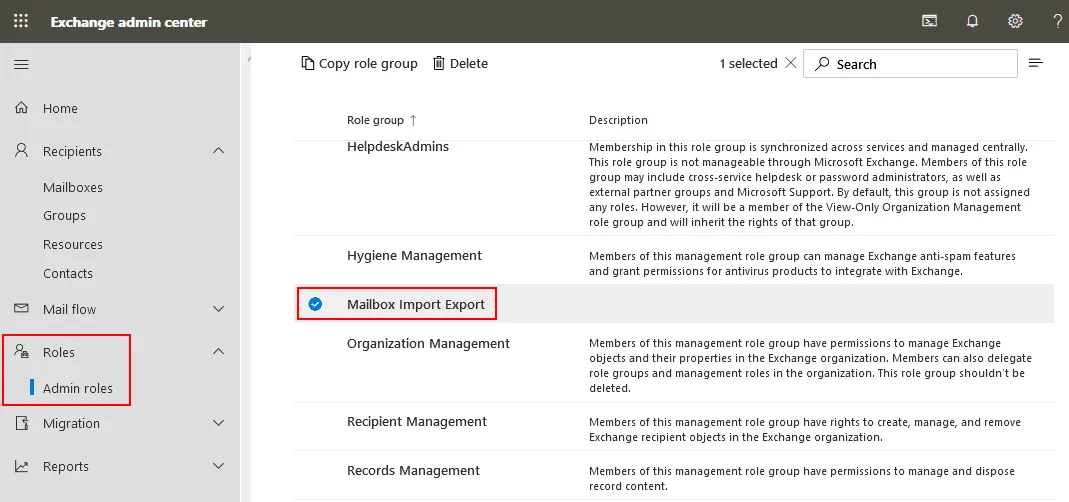
Subsequently yous click the Mailbox Import Export office group on the Admin roles page, the Mailbox Import Export window opens. In the Mailbox Import Export window, select the Assigned tab, hit the + Add push, and add the needed user account to be used for importing PST files to Office 365.

You lot tin edit other permissions and add together roles by clicking Organization Management in the Admin roles list and configuring permissions in the Permissions tab of the Organization management window.
If you are a global administrator of an organization in Function 365, you don't need to assign additional permissions for a global administrator account. The Mail Recipients role must exist assigned to your user account. The Mail service Recipients role is assigned to Recipient Management and Organization Management groups by default.
Log in to Office 365 by using the account that has the required permissions (you may need to log out before logging dorsum in if you are logged in at the moment). You may also need to wait for a few minutes until permissions configuration is applied and changes have event. Microsoft says that the process tin can take upward to 24 hours, but in practice, settings are usually applied inside a few minutes.
Importing PST Files
Now you are set up to showtime to upload PST to Function 365.
Go to https://protection.office.com/ to open up Office 365 Security & Compliance admin heart.
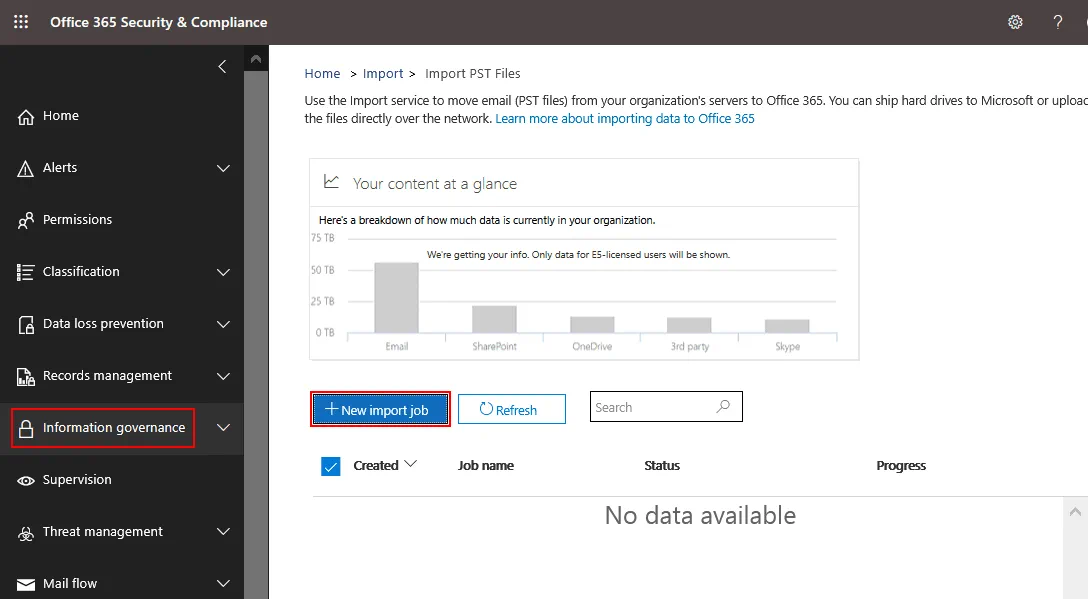
In the navigation pane, click Information governance, then striking Import.
On the Import page, click Import PST Files.

Click New Import Job to create a new job and import PST files to Office 365.
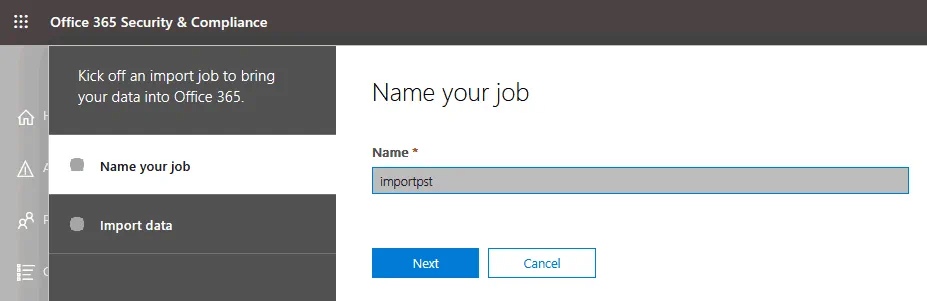
Name your chore. Enter a proper name for your PST files import job, for example, importpst. Hitting Next to continue.
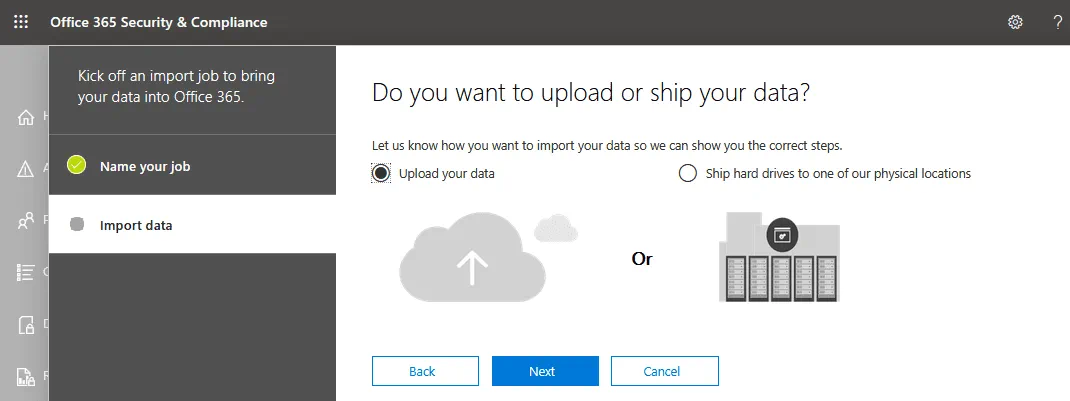
Do yous want to upload or ship your data? Microsoft provides two options to drift PST to Function 365. The first pick is to upload your data via the cyberspace. The second option is to write your data on a hard drive and transport the difficult drive to a Microsoft data center (there is an boosted fee of $ii per gigabyte). I volition upload PST to Role 365 via the internet considering this method is the near affordable if you don't have terabytes of information in your PST files.
Select Upload your data, and hitting Side by side.
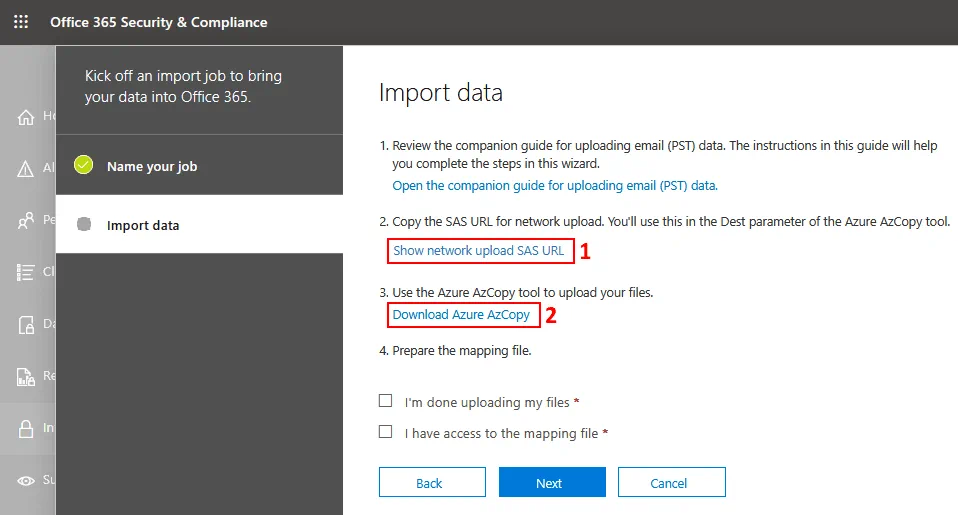
Import data. At this phase, y'all can encounter 4 tips that explain what you should exercise in the corresponding four steps. First, Microsoft recommends that you read their guide to upload PST to Office 365 (see the screenshot below). Now, get to stride 2 and step iii.
Click Show network upload SAS URL.
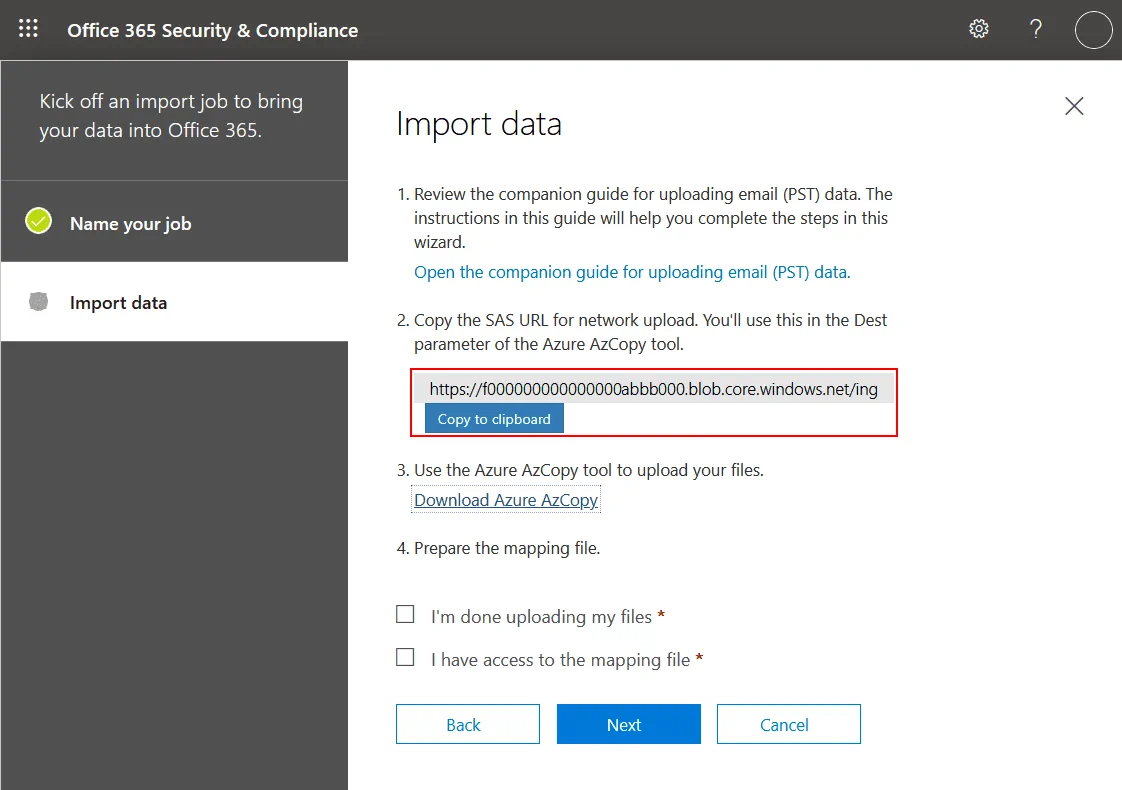
Copy the generated SAS URL, and save this URL in a safe place, for example, in a password-protected text certificate. For security reasons, avoid sharing the SAS URL, which contains the secret Shared Access Signature fundamental, with everyone. The SAS key provides the needed permissions to upload PST files to Microsoft Azure cloud storage. A person who has the SAS URL tin access the PST files uploaded to Azure.
Download Azure AzCopy. Once the AzCopy is downloaded, install this tool. The installation procedure is straightforward. Run the downloaded installation file (MicrosoftAzureStorageAzCopy_netcore_x64.msi in my case) and follow the steps in the wizard to consummate the installation. You lot tin utilise the default installation path.
The default installation path is C:\Program Files (x86)\Microsoft SDKs\Azure\AzCopy
Leave the Import data folio open in your web browser because you lot volition demand this page after.
Run the installed AzCopy application. You can run the AzCopy shortcut in the first carte du jour. Alternatively, open up CMD or PowerShell, go to the folder where AzCopy is installed, and ready to run AzCopy.exe in the command line interface.
Notation : The size of your PST file should non be larger than 20 GB, otherwise functioning of the import process volition be negatively impacted. By default, the maximum size of one email message supported by Office 365 is 35 MB. This size is divers in the MaxReceiveSize property for a mailbox. If a PST file that you desire to import contains messages that are over 35 MB in size, the MaxReceiveSize value can be set to 135 MB, which is the maximum supported value for Office 365 mailboxes.
You lot can check the maximum size of received messages in Substitution Online PowerShell
Get-Mailbox <user mailbox> | FL MaxReceiveSize
You lot can also read this blog mail service almost Part 365 Exchange Online and PowerShell.
Now you have to execute the command in the command line interface to run AzCopy with the needed parameters. The control must exist executed in the following format:
AzCopy.exe /Source:<Location of PST files> /Dest:<SAS URL> /V:<Log file location> /Y
Where:
/Source:<Location if PST files> is the parameter to define the directory where your PST files are located. Yous tin can employ a local path on a local car or a network path to a shared binder on a remote machine. You cannot specify the individual PST file. You can ascertain merely the unabridged folder that contains one or multiple PST files. For example, you can gear up /Source: "C:\temp" or "\\192.168.ane.5\temp\".
/Dest:<SAS URL> is the parameter to define the destination SAS URL that was provided before (and you must relieve this URL in a safe identify).
/5:<Log file location> is used to set the log file location to output the verbose status of importing PST into Function 365 by using Azure deject storage. The default name of the log file is AzCopyVerbose.log, and the default location is %LocalAppData%\Microsoft\Azure\AzCopy
/S – enables the recursive way. Use this control if your source folder specified by the /Source parameter contains subfolders with PST files.
/Y is a required parameter that defines your approving to use write-merely SAS tokens to upload PST to Office 365 by using Azure deject storage. If you don't use the /Y parameter, you lot get an fault, and importing PST files won't start.
Be aware that quotas are required for each parameter where you define a location. Otherwise, an error occurs.
In my case, the command to run AzCopy is as follows:
C:\Plan Files (x86)\Microsoft SDKs\Azure\AzCopy>AzCopy.exe /Source:"D:\temp\pst\" /Dest:" https://f000000000000000abbb000.blob.core.windows.internet/ingestiondata?sv=2015-04-05&sr=c&si=IngestionSasForAzCopy202104120951190643&sig=Cc2122R22Y2222DA22R22C2Q2Q22VZ22q227t2337eE%3D&se=2021-05-12T09%3A51%3A20Z" /V:"D:\temp\log" /Y
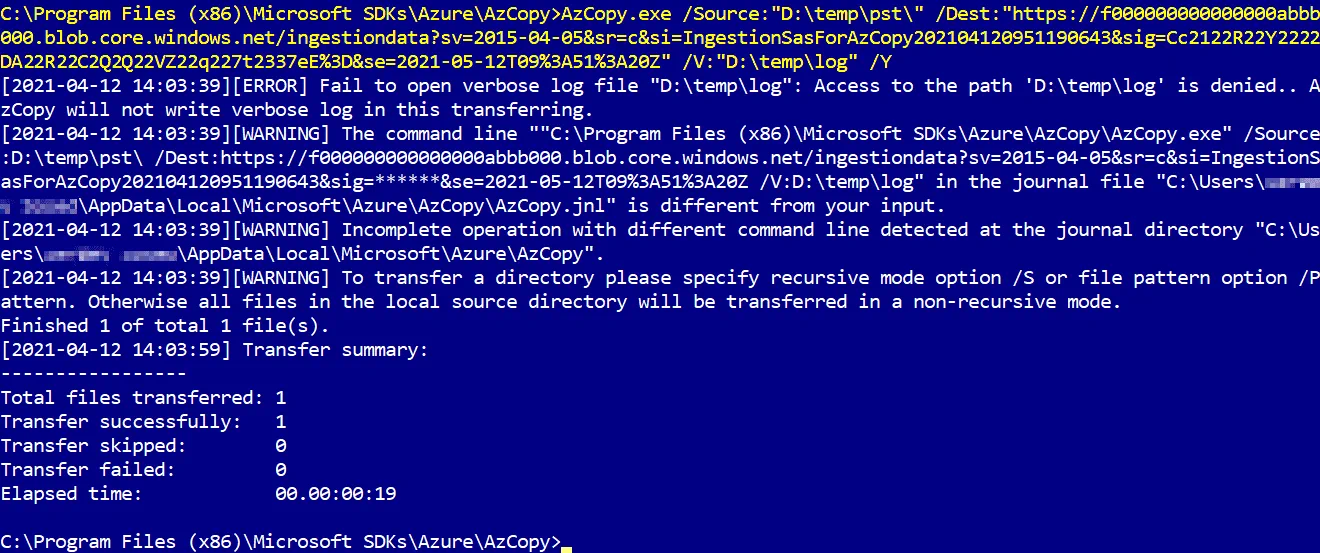
Status messages are displayed afterwards executing the control. Equally you can see in the command line output on the screenshot to a higher place, one PST file has been transferred successfully to Azure cloud storage. If the control was executed correctly, it is recommended that you save this command to a rubber location, for case, to the password-protected document where you saved the SAS URL earlier. If y'all demand to upload PST files to Azure in the future, employ this saved command with the needed parameters.
Verifying that the PST File Has Been Uploaded
Side by side, yous should verify that your PST files take been uploaded to Azure deject storage successfully earlier you continue to migrate PST to Office 365. Verification allows you to ensure that PST files are copied successfully without corruption and prevents possible errors in the following steps. You can also verify the names of uploaded files in Azure and the path of subfolders, which is useful when you need to configure the PST mapping file in the CSV format. With correct names, you have less chances for errors.
Download Microsoft Azure Storage Explorer, which is a free, open up-source tool from the Microsoft website, past using this link:
https://azure.microsoft.com/en-us/features/storage-explorer/
Windows, Linux, and macOS are supported. In my instance, I downloaded the Windows version.
Run the downloaded installer to install the Storage Explorer. The installation procedure is straightforward. Follow the recommendations in the installation wizard to consummate the installation. You can apply the default installation path.
.NET Framework 4.vii.2 or higher is required to run the awarding in Windows (for Azure Storage Explorer 1.18.1).
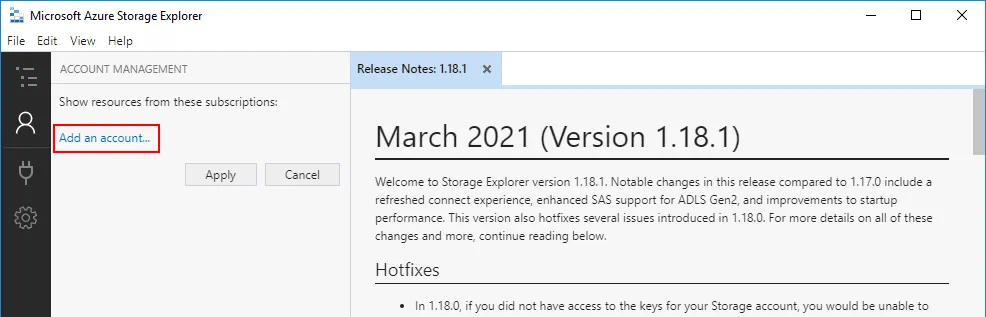
The application has a graphical user interface. One time you lot accept opened Azure Storage Explorer, click Add an account in the Business relationship Management section of the window.
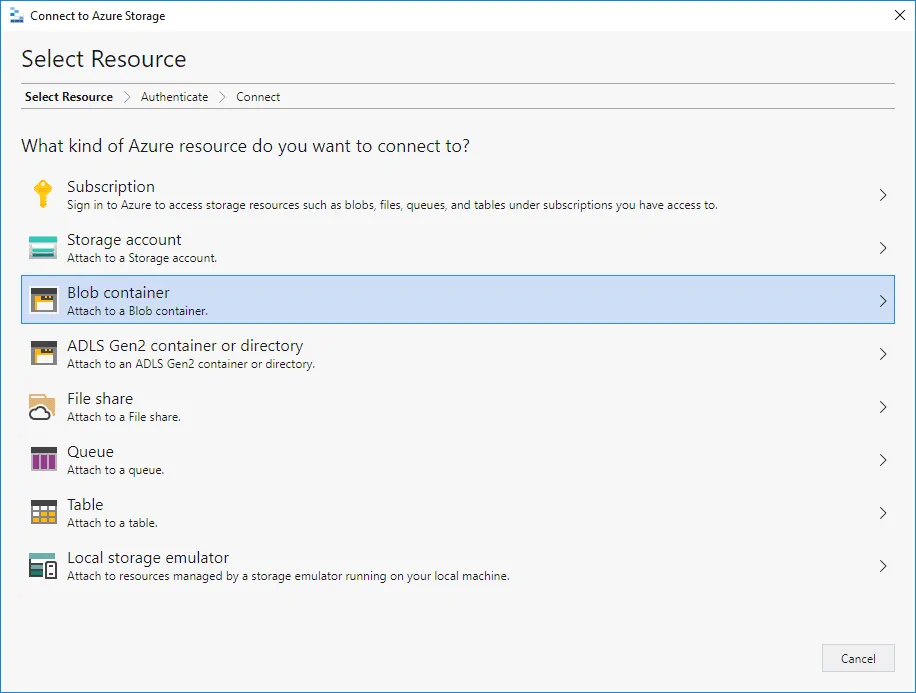
Select Resources. In the window that opens, select the resource where your uploaded PST files are located. Select Blob Container to attach a hulk container to the current instance of Azure Storage Explorer.
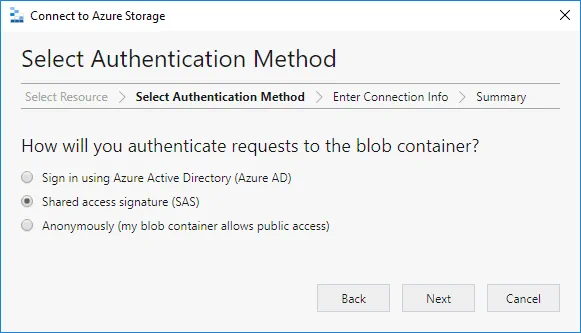
Select Authentication Method. Select Shared Access Signature (SAS) to authenticate requests of Azure Storage Explorer to the blob container. So hit Adjacent to continue.
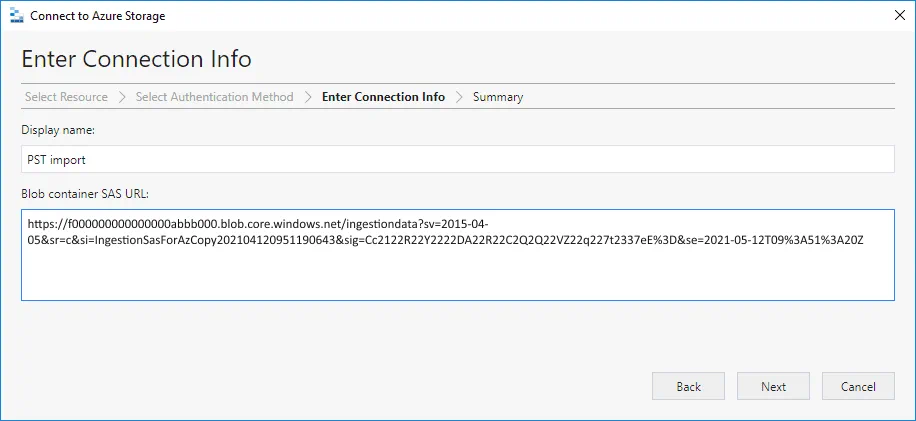
Enter Connection Info. Enter a display proper noun, for example, PST import. And so enter the blob container SAS URL (that you obtained before and saved to a safe location) in the advisable field. Hit Next.
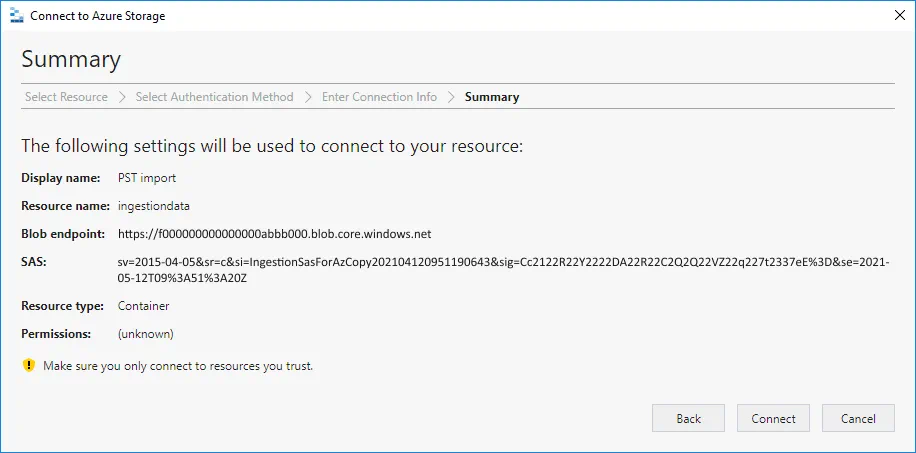
Summary. Check your settings that will be used to connect to your source in the Azure cloud where the PST files are located at present. If everything is correct, click the Connect push button.
Now Microsoft Azure Storage Explorer is connected to the needed blob container in Azure storage. On the screenshot beneath, yous can see that my PST file (Michael Bose pst) has been uploaded successfully.
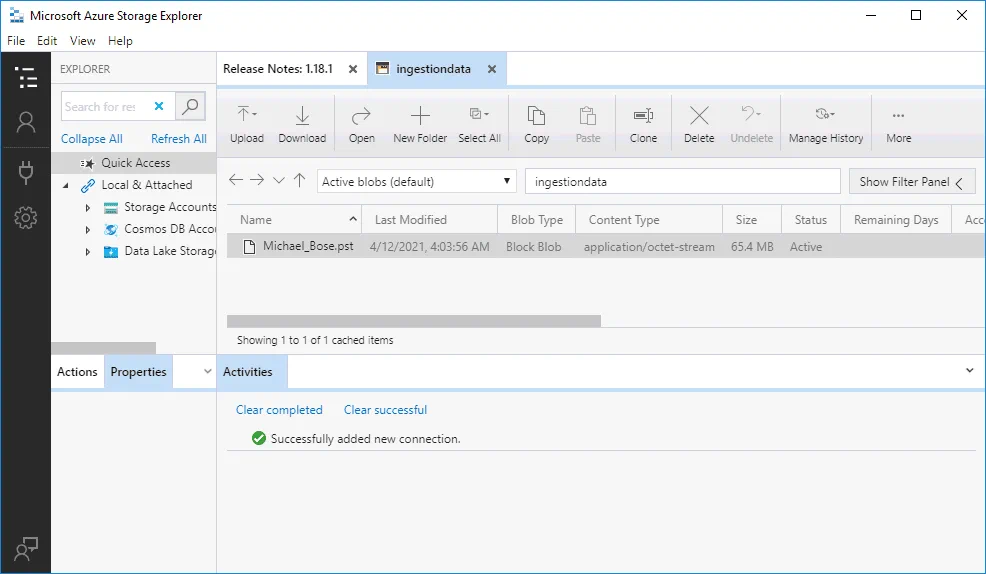
Afterward you verify that the import to Azure has been completed successfully, you can disconnect from Azure storage and shut Azure Storage Explorer.
Creating the PST Mapping File
After uploading PST files to Azure and checking them, create the PST mapping file to define which PST files must be imported to which Part 365 user accounts. The mapping file is saved in a CSV format (comma-separated value).
Download the template to map PST files to Function 365 user accounts from the Microsoft website:
https://get.microsoft.com/fwlink/p/?LinkId=544717
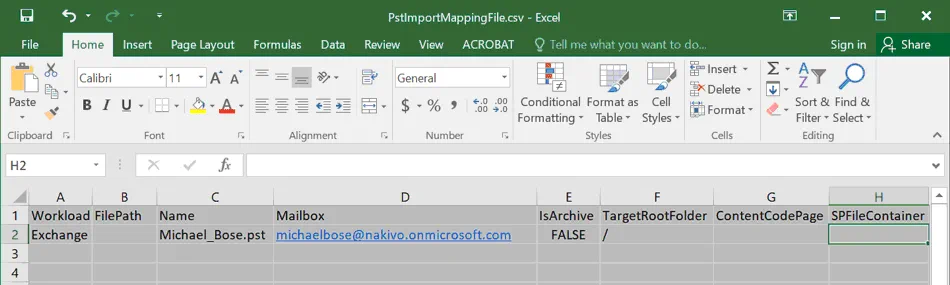
The file proper name is PstImportMappingFile.csv in this case. Open this CSV file in a spreadsheet editor, such every bit Microsoft Part Excel, to edit the file. Don't change whatever information in the first row (the header row). Create one row for each PST file. Allow me go over each column and explain which parameters you should enter.
Workload. This parameter is used to specify the service to which data must exist imported. As you are importing PST files to Exchange, enter the Exchange value for all cells of this cavalcade.
FilePath. You tin can specify a folder proper name in Azure storage if you lot have used subfolders in previous steps when importing PST files to the cloud. If you have not specified subfolders, leave this parameter blank. I'yard leaving the parameters in the FIlePath column bare.
Proper name. Enter the name of the PST file for each user business relationship. The PST file name in this tabular array must be the same equally the proper noun of the source PST file that was imported to Azure cloud storage from your local machine. The parameters for each user account are defined in a split up row. In my example, I am importing ane PST file of Michael Bose, and I have to enter the proper name of this PST file (Michael_Bose.pst). This value is instance sensitive. The name of the CSV file must exist unique for each user.
Mailbox. Specify the email address of the destination Role 365 user mailbox for each PST file. Each PST file will be imported to the appropriate destination Office 365 mailbox yous set up in this column. Public folders are not supported. You tin import PST to Office 365 inactive mailboxes. Run the Get-Mailbox <identity of inactive mailbox> -InactiveMailboxOnly | FL Guid command in Substitution Online PowerShell to obtain the GUID of the inactive mailbox. Then enter the GUID in the Mailbox field of the inactive user to ascertain this parameter instead of entering the name of the user business relationship. You can as well ascertain a unique GUID instead of a mailbox proper name for agile users. If you need the GUID for an active mailbox, utilise the Get-Mailbox <identity of agile mailbox> | FL Guid command. To get the GUID of a soft-deleted mailbox, use the Get-Mailbox <identity of soft-deleted or inactive mailbox> -SoftDeletedMailbox | FL Guid command. In my example, I am importing one PST file of Michael Bose and using the michaelbose@nakivo.microsoft.com Function 365 account as the destination.
IsArchive. This parameter has two values: TRUE and FALSE. Apply the TRUE value if you lot need to import the PST file to a user'southward annal mailbox (the annal mailbox must be enabled in this instance). Use the Simulated value to import a PST file to a user'south master mailbox. If you define the Truthful value for a mailbox and the archive mailbox is not enabled for this user account, the import operation will fail for the current user. If the IsArchive parameter is defined correctly for other users of the PST files import task, these users are non affected. In my example, I don't need to employ the annal mailbox, and as a upshot, I use the FALSE value.
TargetRootFolder. Utilise this parameter to specify the mailbox folder for a user'southward email account in Exchange Online. If you lot specify /PSTimported equally TargetRootFolder, the PSTimported binder will be created in a user's mailbox, and all data volition be imported to the appropriate subfolders of this folder. If you leave this parameter blank, a PST file is imported to the Imported folder, which is automatically created at the root level of the mailbox binder structure for the current user. If you ascertain / as the TargetRootFolder parameter, then import the content of the PST file to the acme of the folder structure in the destination mailbox of a target Role 365 user.
ContentCodePage. This parameter specifies the code page for importing PST files into Office 365 in the ANSI format. In almost cases, you should utilize the blank value (default). Yous tin set 932 if you want to use the ANSI/OEM Japanese code page.
Get out empty other fields on the correct side.
Save changes to the CSV file after completing configuration. It is recommended that you create at least one test batch by using a CSV file with a pocket-size number of users and attempt importing PST into Role 365 with this configuration. If everything works properly, run the PST file import job with the full list of users and the configured CSV file. The content of my CSV file used in this walkthrough is displayed on the screenshot below.
Creating the PST File Import Job
You are prepare for the last phase of importing PST files to Office 365 mailboxes. Go back to the Import information window, which should exist open still in your web browser. You take copied the SAS URL from this page earlier. If you've close this tab in the web browser, you can re-open the page afterwards opening the Office 365 Security & Compliance admin center (Information governance > Import).
After you have uploaded CSV files to Azure cloud storage and configured the CSV file, which is attainable on your machine, select the checkboxes:
- I'm done uploading my files
- I have admission to the mapping file
And so hit Next to keep.

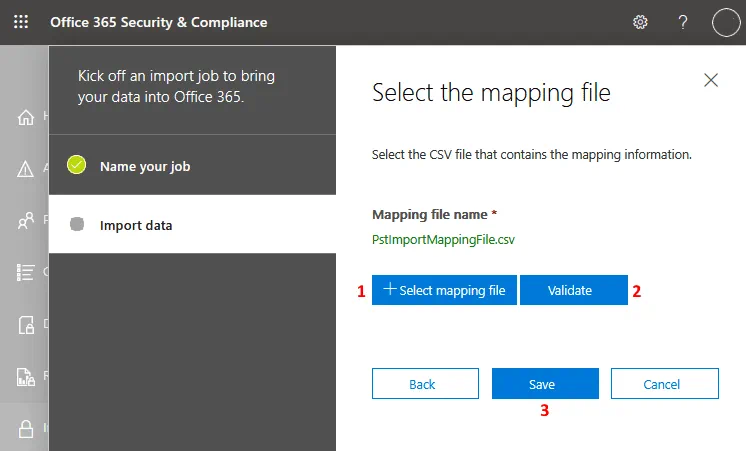
Select the mapping file. Click Select mapping file, and in the popular-up window, select the CSV file that contains the mapping information. Upload your CSV file. After selecting and uploading your CSV file, click the Validate push to bank check for common errors in the mapping file. If in that location are no errors, the file name is colored green. And so hit Salve.
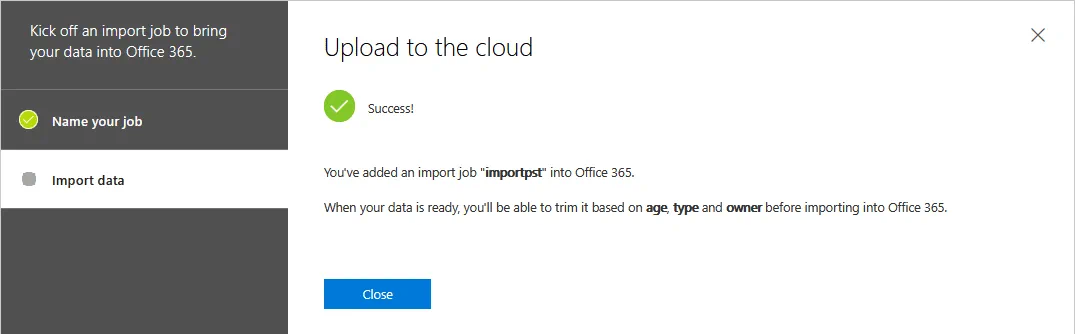
The PST file import chore is now added, and the Success condition is displayed. Y'all can shut this window.
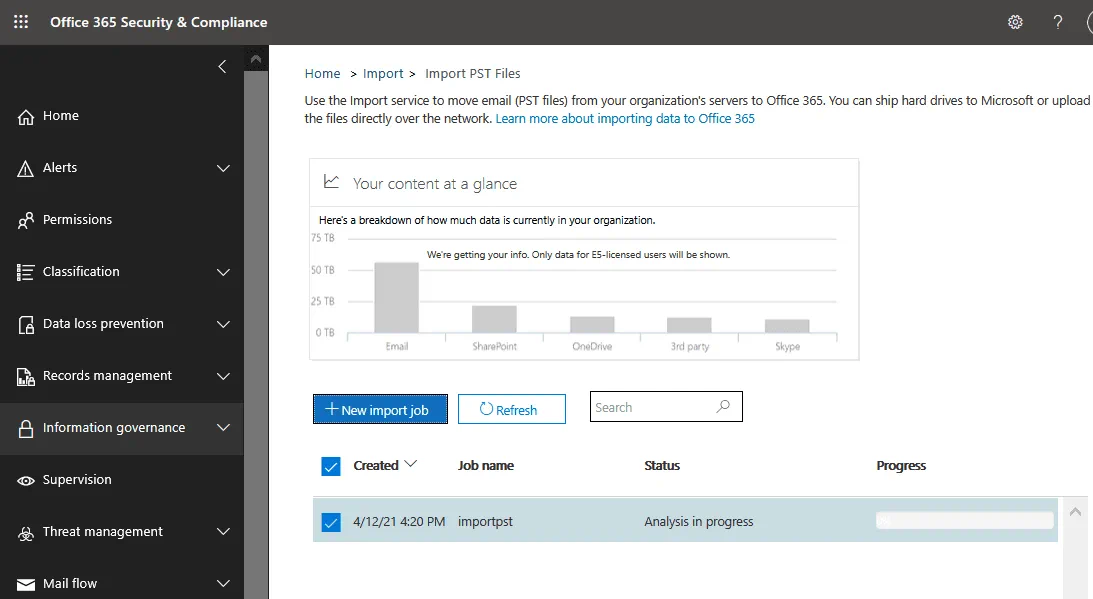
Importing PST into Office 365 is being started now. Cheque the status of your PST files import job by clicking Refresh. At the starting time of importing PST files to Office 365 mailboxes, the status is Analysis in progress (see the screenshot).
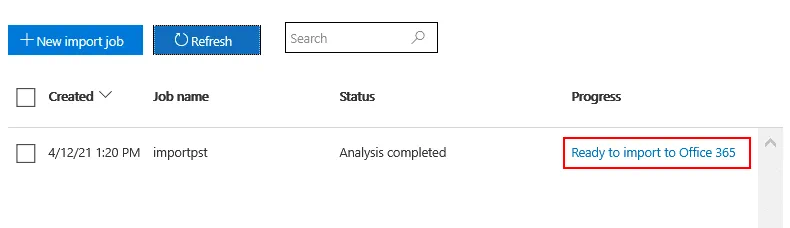
Once the assay is completed, click Ready to import to Part 365.
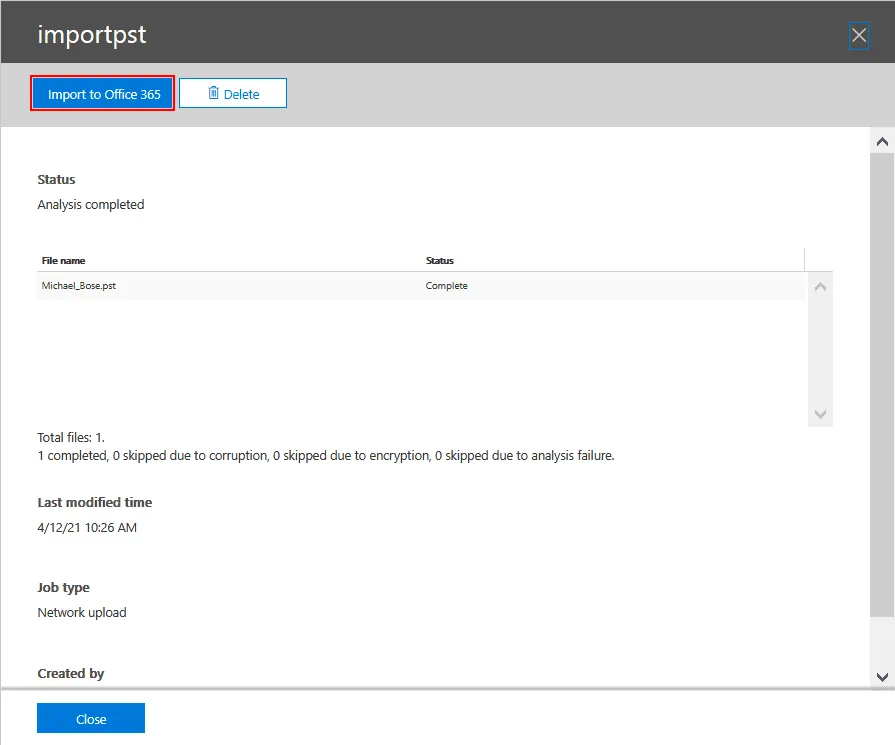
In the window that opens, check your uploaded PST files, and click Import to Office 365.
Information filtering
Yous tin configure data filtering options to ascertain which data should exist imported to Office 365 user mailboxes. On the Filter your data step, specify whether you want to filter your information. Select one of the options:
- Yeah, I want to filter data before importing
- No, I desire to import everything
Click Next to continue.
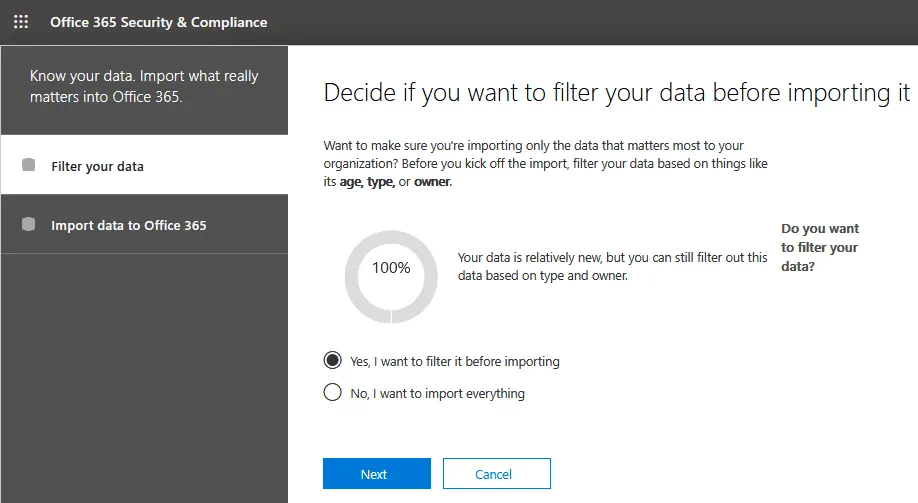
If yous choose to filter your information, you lot can select filtering options, such as to import data based on the age of data. For example, y'all can select to import information less than 2 years old or import data that is less than i year former. Click More filtering options to select the message types to import or select messages received/sent by specific users. Filtering options depend on the analysis of PST files performed before past Office 365. Striking Side by side to continue.
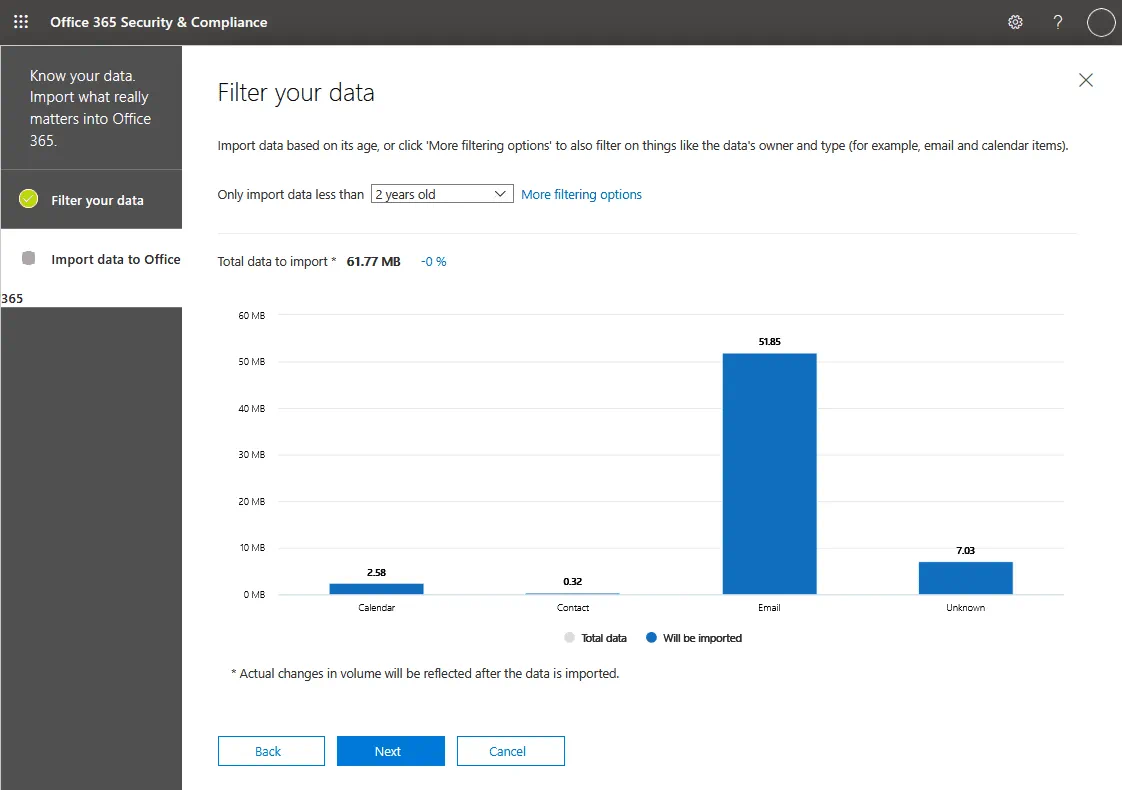
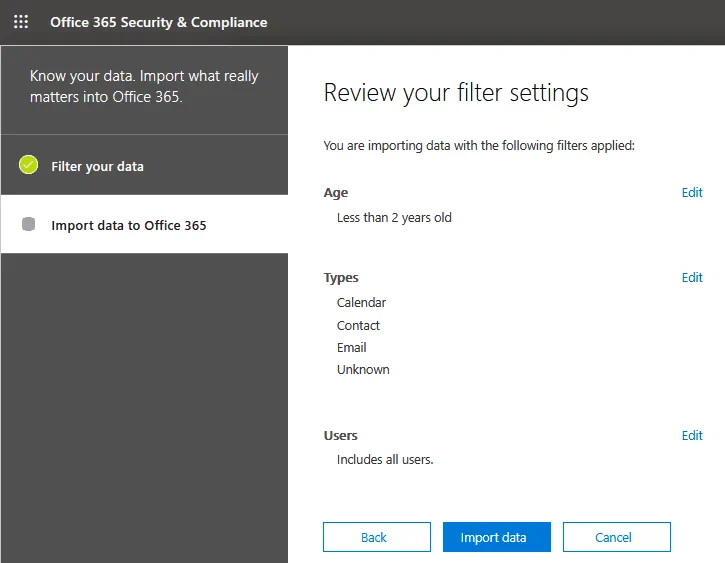
Review your filter settings. Check the defined filtering settings to import information from PST files to Role 365. If the settings are right, click Import data to starting time importing PST files to Part 365 mailboxes.
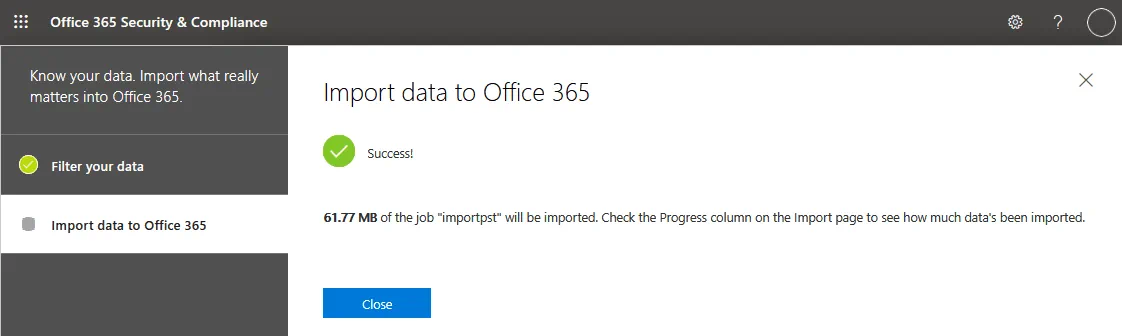
The Success status is displayed in my case. You can read the data virtually the amount of data that volition be imported and then close this window.
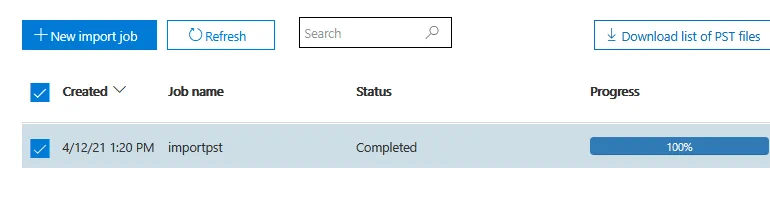
Wait until importing PST files to Part 365 mailboxes has finished. You tin can click Refresh and check the chore status on the Import PST files page. While the job is running, the status is Import in progress. Be patient and wait until the chore is completed. The process is fourth dimension-consuming. You can shut this tab in your browser and re-open this folio afterward to bank check the status.
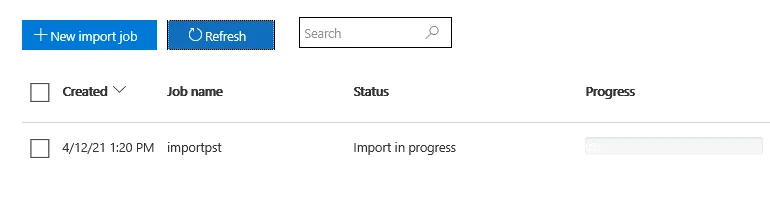
When the job is completed, the Completed status and 100% are displayed in the progress bar.
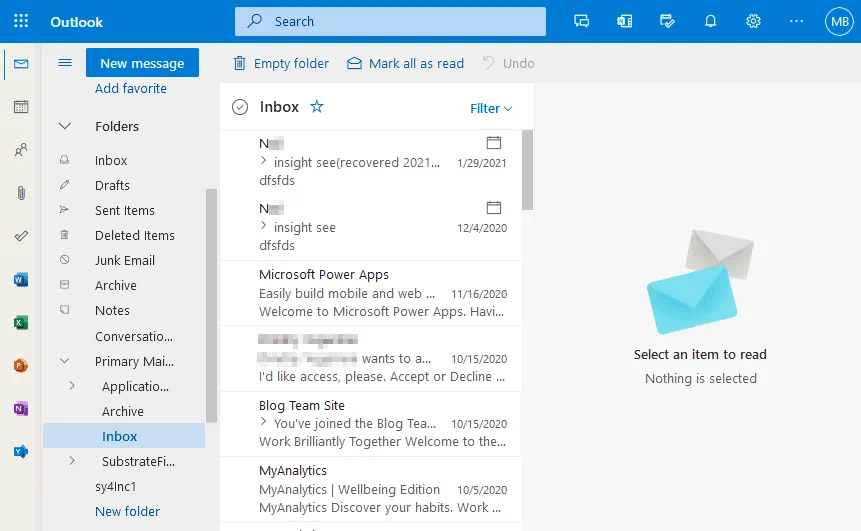
When importing PST files is completed, you tin check the imported data in the mailbox. Let'southward log in to https://outlook.part.com and check the imported data for my email account used in this tutorial. As y'all can see on the screenshot below, data was imported to the Primary Mailbox folder. For case, the imported mailbox folder is located in Primary mailbox > Mailbox.
Decision
This blog mail service has covered importing PST files to Office 365, which is useful afterward migrating to Function 365 from other email services. You can use native Microsoft tools to drift data from PST files to Office 365 user mailboxes. Ane of the advantages of importing PST files to Role 365 is the power to access onetime email data from whatsoever machine connected to the internet even if the user doesn't have access to the machine on which the email client with the PST file is installed. Some other advantage of importing PST files to Part 365 is the ability to back up the information of all Part 365 users within an organization centrally.
NAKIVO Backup & Replication is a universal data protection solution that supports Office 365 backup and recovery. The solution can back upward Substitution Online, including email messages, OneDrive, and SharePoint Online data. You can recover entire mailboxes or individual emails to source mailboxes or to the mailboxes of other Office 365 users. Download the Complimentary Edition of NAKIVO Backup & Replication and try the product today.
Source: https://www.nakivo.com/blog/migrating-pst-files-to-office-365/
0 Response to "Can I Split a Pst File and Upload It to a Office 365 Mailbox?"
Postar um comentário